
Lenten Meditation, Second Sunday of Lent 2026
For the best copy of this Meditation, with all formatting in place, click here for the PDF:
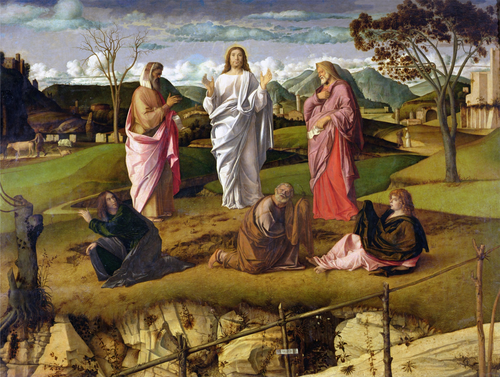
Seeing the Painting
Matthew 17 (NJB): 2 There in their presence he was transfigured: his face shone like the sun and his clothes became as dazzling as light.3
Notice how ordinary is the scene he paints. There is little suggestion of the intensities being expressed in the biblical text – “shone like the sun” and “dazzling as light”. The three disciples seem sleepy, or perhaps bored and distracted. They do not appear impressed.
I admit that I have long been puzzled by this biblical scene, because the visual magnificence described in the biblical account seems a “showing off” that Jesus without question would have found repugnant.
Matthew 17 (NJB): 2 There in their presence he was transfigured: his face shone like the sun and his clothes became as dazzling as light.3
Notice how ordinary is the scene he paints. There is little suggestion of the intensities being expressed in the biblical text – “shone like the sun” and “dazzling as light”. The three disciples seem sleepy, or perhaps bored and distracted. They do not appear impressed.
I admit that I have long been puzzled by this biblical scene, because the visual magnificence described in the biblical account seems a “showing off” that Jesus without question would have found repugnant.
Amy Grant, Age to Age (released 1982), “El Shaddai” -
Through the years You've made it clear,
That the time of Christ was near,
Though the people couldn't see
What Messiah ought to be.
Though Your Word contained the plan,
They just could not understand
Your most awesome work was done
Through the frailty of Your Son.
First, Jesus was not a show-off. So, what do you think about this moment in the life of Jesus? In the theology of the Rosary, this mystery in the life of Christ is placed not among the glorious mysteries to our surprise but among the luminous mysteries (the five mysteries that Pope St. John Paul II added to the Rosary in 2002)4.
Second, the deliberately “unimpressive” way Bellini presents this scene (no flash; nothing to startle) suggests that our painter was paying attention not to the dazzling5 display but to something more compelling and powerful, wanting us to notice that instead. What if what he “remembered” about this scene was the profound stillness inside of which all this happened and, most of all, what he felt inside that stillness.
It is the “thickness” and resonant depth of that stillness that comes through to me, and what it enabled me to see and to hear. And then the sound of those unhurried voices quietly speaking – those of Jesus and Moses and Elijah.
Quotes
C.S. Lewis “The Weight of Glory”, a Sermon preached at the Church of St. Mary the Virgin in the High Street, Oxford on Monday, 8 June 1942, taken from the closing lines: “This does not mean that we are to be perpetually solemn. We must play. But our merriment must be of that kind (and it is, in fact, the merriest kind) which exists between people who have, from the outset, taken each other seriously—no flippancy, no superiority, no presumption. And our charity must be a real and costly love, with deep feeling for the sins in spite of which we love the sinner—no mere tolerance or indulgence which parodies love as flippancy parodies merriment. Next to the Blessed Sacrament itself, your neighbour is the holiest object presented to your senses. If he is your Christian neighbour, he is holy in almost the same way, for in him also Christ vere latitat [Latin: “truly he hides”]—the glorifier and the glorified, Glory Himself, is truly hidden.”
“But what does it all mean?” asked Susan when they were somewhat calmer. “It means,” said Aslan, “that though the Witch knew the Deep Magic, there is a magic deeper still which she did not know. Her knowledge goes back only to the dawn of time. But if she could have looked a little further back, into the stillness and the darkness before Time dawned, she would have read there a different incantation. She would have known that when a willing victim who had committed no treachery was killed in a traitor’s stead, the Table would crack and Death itself would start working backward. [Lewis, C.S. The Lion, the Witch and the Wardrobe (Chronicles of Narnia Book 2), pp. 98-99. Kindle Edition. My emphasis.]
It is the “thickness” and resonant depth of that stillness that comes through to me, and what it enabled me to see and to hear. And then the sound of those unhurried voices quietly speaking – those of Jesus and Moses and Elijah.
Quotes
C.S. Lewis “The Weight of Glory”, a Sermon preached at the Church of St. Mary the Virgin in the High Street, Oxford on Monday, 8 June 1942, taken from the closing lines: “This does not mean that we are to be perpetually solemn. We must play. But our merriment must be of that kind (and it is, in fact, the merriest kind) which exists between people who have, from the outset, taken each other seriously—no flippancy, no superiority, no presumption. And our charity must be a real and costly love, with deep feeling for the sins in spite of which we love the sinner—no mere tolerance or indulgence which parodies love as flippancy parodies merriment. Next to the Blessed Sacrament itself, your neighbour is the holiest object presented to your senses. If he is your Christian neighbour, he is holy in almost the same way, for in him also Christ vere latitat [Latin: “truly he hides”]—the glorifier and the glorified, Glory Himself, is truly hidden.”
Alfred Lord Tennyson (1809-1892)6 – “In Memoriam” (the last stanzas) –
Thoughts
As I earlier suggested, I have wondered about what Jesus was showing those three disciples that night. I am convinced that we have missed something important. What is it?
Ring out false pride in place and blood,
The civic slander and the spite;
Ring in the love of truth and right,
Ring in the common love of good.
Ring out old shapes of foul disease;
Ring out the narrowing lust of gold;
Ring out the thousand wars of old,
Ring in the thousand years of peace.
Ring in the valiant man and free,
The larger heart, the kindlier hand;
Ring out the darkness of the land,
Ring in the Christ that is to be.7
Thoughts
As I earlier suggested, I have wondered about what Jesus was showing those three disciples that night. I am convinced that we have missed something important. What is it?
Ephesians 3 (NJB): 19 so that, knowing the love of Christ, which is beyond knowledge, you may be filled with the utter fullness of God. 20 Glory be to him whose power, working in us, can do infinitely more than we can ask or imagine …8
The commentators ancient and contemporary conclude to the hidden divinity of the God-Man suddenly flashing forth in/through Him, which to this point had been unseen by the disciples. It was as if a great oaken door, behind which was a boundless Heaven boiling with life,9 swung open just enough to let through into a land of shadows a magnificent brightness.
It could be that it was His divine nature that He was revealing to them. But I don’t think so. It is just too unlike Jesus to allow such a display, a drawing attention to Himself. And then we have this text of obvious pertinence:
The key word is that He emptied Himself of that which could “flash out”, making an impressive display on the mountain, offering proof of how unlike He was to us who are not in the habit of being effulgent.
What, then, was Jesus showing them?
I have recently been learning from this text of John Chrysostom:
It could be that it was His divine nature that He was revealing to them. But I don’t think so. It is just too unlike Jesus to allow such a display, a drawing attention to Himself. And then we have this text of obvious pertinence:
Philippians 2 (NJB):
6 Who, being in the form of God,
did not count equality with God
something to be grasped.
7 But he emptied himself,
taking the form of a slave,
becoming as human beings are;
and being in every way like a human being …10
The key word is that He emptied Himself of that which could “flash out”, making an impressive display on the mountain, offering proof of how unlike He was to us who are not in the habit of being effulgent.
The Oxford English Dictionary at “effulgent” – 1737 - Shining forth brilliantly; sending forth intense light; resplendent, radiant.
What, then, was Jesus showing them?
I have recently been learning from this text of John Chrysostom:
St. John Chrysostom (c. 347-407 CE): “When the devil, as you remember, evil spirit and enemy of our nature as he is, saw the first human being living in the garden, how his life was carefree and how he lived on earth in bodily form yet like an angel, (23d) he wanted to trip him up and dislodge him with the hope of greater promises, and so he cheated him of the possession of what he had.”11
This text caused me to recall something that I learned some years ago when I was studying the Hymns on Paradise of St. Ephrem the Syrian (c. 306-373 CE)12. Ephrem, unlike any other theologian I had ever read, contemplated what he had textually no means to see, but about which he asked God to teach him. What was the nature of the first human beings whom God made from the dust of the Earth, placing them in Paradise? What were we like there? Don’t we need to know this for us to understand the restoration being offered us by God in the holy redemption?
What God gave Ephrem to understand is that before the Fall, God had made us powerful and beautiful and formidable and alight with mirth, human beings who were far more than what we weakly imagine that we are or could possibly be. Think of the insight in Psalm 8:
The Oxford English Dictionary at “to restore” – II.4.a. - a1325 – transitive. To grant to or obtain for (a person, etc.) reinstatement to (also †of) former rank, office, or possessions.
What God gave Ephrem to understand is that before the Fall, God had made us powerful and beautiful and formidable and alight with mirth, human beings who were far more than what we weakly imagine that we are or could possibly be. Think of the insight in Psalm 8:
5 Yet you have made him little less than a god,
you have crowned him with glory and beauty,
6 made him lord of the works of your hands,
put all things under his feet.13
What Jesus showed His three closest friends that night on the mountain was not the awe-inspiring greatness of His divine nature; it was instead a fully restored human nature that He showed them, restored to its paradisal14 glory - human beings fully alive – gloria Dei est vivens homo15. We were His work of Art there in Paradise, terrible16 beauties, “not tame, but good.”17
If we were then as we regularly (always?) imagine ourselves to be now, then why would the Satan have bothered with us? Why would he have felt threatened by us? He would not have felt that. But Satan was threatened by the terrible beauty whom God made us to be in Paradise. And then an envy that he could not resist laid hold of him.
How could we not have been made terrifyingly powerful and beautiful and gentle and wise and filled with mirth and playful in highest degree? We were (and are) God’s work of Art, made not by word only but by His own hands working in the dust of the Earth, the very image and likeness of our Maker.19
If we were then as we regularly (always?) imagine ourselves to be now, then why would the Satan have bothered with us? Why would he have felt threatened by us? He would not have felt that. But Satan was threatened by the terrible beauty whom God made us to be in Paradise. And then an envy that he could not resist laid hold of him.
Wisdom 2 (NJB): 24 Death came into the world only through the Devil’s envy, as those who belong to him find to their cost.18
How could we not have been made terrifyingly powerful and beautiful and gentle and wise and filled with mirth and playful in highest degree? We were (and are) God’s work of Art, made not by word only but by His own hands working in the dust of the Earth, the very image and likeness of our Maker.19
Genesis 1 (NJB): 26 God said, ‘Let us make man in our own image, in the likeness of ourselves.’20
Doesn’t it make much more sense that what Jesus showed us in the Transfiguration is what a fully human, fiercely and finally free, person is, the Form of human being that He came to restore, who was Himself that restored humanity?
For us to continue to say that Jesus “frees me from my sins” and then leave it at that - Christ was doing so much more than that! - is to indulge a vision of human beings that is insufficient, suffocatingly minimalist, a narrowing of what restoration in Christ offers us. Consider again:
Ephesians 3 (NJB): 19 so that, knowing the love of Christ, which is beyond knowledge, you may be filled with the utter fullness of God. 20 Glory be to him whose power, working in us, can do infinitely more than we can ask or imagine …21
The Transfiguration reveals not a divine being, but a human being [not an angel; not a god] fully alive, fully restored in Christ – whom God made and with whom it pleased Him to walk in the Garden in times past.
Prayer for the Second Sunday of Lent
O God, who have commanded us
to listen to your beloved Son,
be pleased, we pray,
to nourish us inwardly by Your word,
that, with spiritual sight made pure,
we may rejoice to behold your glory.22
Notes
1 To study the painting: https://commons.wikimedia.org/wiki/File:The-Transfiguration-1480-xx-Giovanni-Bellini.JPG.
2 Grove Art Online (Oxford), Peter Humfrey on Giovanni Bellini – Italian painter and draughtsman, son of Jacopo Bellini. Although the professional needs of Giovanni Bellini’s family background may have encouraged him to specialize at an early date in devotional painting (see fig.), by the 1480s he had become a leading master in all types of painting practiced in 15th-century Venice. … The qualities of calm dignity and spiritual depth found in the best of Bellini’s small-scale devotional images also appear in the succession of church altarpieces that he produced throughout his career. … All are masterpieces, and they set the standards of quality and of innovative design against which all other Venetian altar paintings, and eventually altarpieces throughout Italy, came to be measured.
3 The New Jerusalem Bible. Doubleday, 1990, p. Mt 17:2.
4 See the Apostolic Letter of Pope John Paul II on 16 October 2002. See https://www.vatican.va/content/john-paul-ii/en/apost_letters/2002/documents/hf_jp-ii_apl_20021016_rosarium-virginis-mariae.html - “The Rosary of the Virgin Mary, which gradually took form in the second millennium under the guidance of the Spirit of God, is a prayer loved by countless Saints and encouraged by the Magisterium. Simple yet profound, it remains at the dawn of this third millennium a prayer of great significance, destined to bring forth a harvest of holiness.”
2 Grove Art Online (Oxford), Peter Humfrey on Giovanni Bellini – Italian painter and draughtsman, son of Jacopo Bellini. Although the professional needs of Giovanni Bellini’s family background may have encouraged him to specialize at an early date in devotional painting (see fig.), by the 1480s he had become a leading master in all types of painting practiced in 15th-century Venice. … The qualities of calm dignity and spiritual depth found in the best of Bellini’s small-scale devotional images also appear in the succession of church altarpieces that he produced throughout his career. … All are masterpieces, and they set the standards of quality and of innovative design against which all other Venetian altar paintings, and eventually altarpieces throughout Italy, came to be measured.
3 The New Jerusalem Bible. Doubleday, 1990, p. Mt 17:2.
4 See the Apostolic Letter of Pope John Paul II on 16 October 2002. See https://www.vatican.va/content/john-paul-ii/en/apost_letters/2002/documents/hf_jp-ii_apl_20021016_rosarium-virginis-mariae.html - “The Rosary of the Virgin Mary, which gradually took form in the second millennium under the guidance of the Spirit of God, is a prayer loved by countless Saints and encouraged by the Magisterium. Simple yet profound, it remains at the dawn of this third millennium a prayer of great significance, destined to bring forth a harvest of holiness.”
5 The Oxford English Dictionary at “to dazzle” – 3. – 1536 – transitive. To overpower, confuse, or dim (the vision), esp. with excess of brightness. (Also figurative)
6 Britannica – Alfred, Lord Tennyson (born August 6, 1809, Somersby, Lincolnshire, England—died October 6, 1892, Aldworth, Surrey) was an English poet often regarded as the chief representative of the Victorian age in poetry. He was raised to the peerage in 1884. Among his famous works are “The Lotos-Eaters,” “Ulysses,” “The Charge of the Light Brigade,” In Memoriam, and Idylls of the King.
7 I have placed this poem here in specific acknowledgement of a friend of mine who is in the grip of Pancreatic cancer, or more to the point, who is in the hands of God, those same hands that formed the first of us from the dust of the Earth and then breathed in life.
8 The New Jerusalem Bible. Doubleday, 1990, p. Eph 3:19–20.
6 Britannica – Alfred, Lord Tennyson (born August 6, 1809, Somersby, Lincolnshire, England—died October 6, 1892, Aldworth, Surrey) was an English poet often regarded as the chief representative of the Victorian age in poetry. He was raised to the peerage in 1884. Among his famous works are “The Lotos-Eaters,” “Ulysses,” “The Charge of the Light Brigade,” In Memoriam, and Idylls of the King.
7 I have placed this poem here in specific acknowledgement of a friend of mine who is in the grip of Pancreatic cancer, or more to the point, who is in the hands of God, those same hands that formed the first of us from the dust of the Earth and then breathed in life.
8 The New Jerusalem Bible. Doubleday, 1990, p. Eph 3:19–20.
9 “boiling with life” – This phrase I remember from reading Plotinus (3rd century). See his Ennead VI.12 where it reads in part: “Conceive it as a power of an ever-fresh infinity, a principle unfailing, inexhaustible, at no point giving out, brimming over with its own vitality. If you look to some definite spot and seek to fasten on some definite thing, you will not find it. The contrary is your only way; you cannot pass on to where it is not; you will never halt at a dwindling point where it fails at last and can no longer give; you will always be able to move with it—better, to be in its entirety—and so seek no further; denying it, you have strayed away to something of another order and you fall; looking elsewhere you do not see what stands there before you.” [Plotinus. Plotinus: On the One and Good: Being the Treatises of the Sixth Ennead. Translated by Stephen MacKenna and B. S. Page, vol. V, The Medici Society; Hale, Cushman & Flint, 1930, p. 137.]
10 The New Jerusalem Bible. Doubleday, 1990, p. Php 2:6–7.
10 The New Jerusalem Bible. Doubleday, 1990, p. Php 2:6–7.
11 John Chrysostom. Homilies on Genesis 1–17. Edited by Thomas P. Halton, Translated by Robert C. Hill, vol. 74, The Catholic University of America Press, 1986, p. 23.
12 Ephrem of Nisibis (feast in the Syrian church 28 January or 1 February; in the Byzantine rite 28 January; in the Coptic rite 9 July; in the Latin church 9 July or 1 February, at present 18 June) is unquestionably the most important of the Syrian Fathers and the greatest poet of the patristic era. His original work is, with that of Aphraates, an irreplaceable link in the chain of the Eastern tradition. Witness to a Jewish Christianity that developed on the fringe of the Roman Empire, he placed the biblical-semitic tradition and its symbols in opposition to the influence of Greek philosophy. His poetic genius, often badly imitated by his Syrian successors, still animates the Eastern liturgies today, and is inherited by the Byzantine branch through the oblique line of Romanus Melodus’s kontakion. [Rilliet, Frédéric. “Ephrem the Syrian.” Encyclopedia of Ancient Christianity, edited by Angelo Di Berardino and James Hoover, translated by Joseph T. Papa et al., vol. 1, IVP Academic; InterVarsity Press, 2014, p. 810.]
13 The New Jerusalem Bible. Doubleday, 1990, p. Ps 8:5–6.
12 Ephrem of Nisibis (feast in the Syrian church 28 January or 1 February; in the Byzantine rite 28 January; in the Coptic rite 9 July; in the Latin church 9 July or 1 February, at present 18 June) is unquestionably the most important of the Syrian Fathers and the greatest poet of the patristic era. His original work is, with that of Aphraates, an irreplaceable link in the chain of the Eastern tradition. Witness to a Jewish Christianity that developed on the fringe of the Roman Empire, he placed the biblical-semitic tradition and its symbols in opposition to the influence of Greek philosophy. His poetic genius, often badly imitated by his Syrian successors, still animates the Eastern liturgies today, and is inherited by the Byzantine branch through the oblique line of Romanus Melodus’s kontakion. [Rilliet, Frédéric. “Ephrem the Syrian.” Encyclopedia of Ancient Christianity, edited by Angelo Di Berardino and James Hoover, translated by Joseph T. Papa et al., vol. 1, IVP Academic; InterVarsity Press, 2014, p. 810.]
13 The New Jerusalem Bible. Doubleday, 1990, p. Ps 8:5–6.
14 Recall that “paradise” is not “Heaven”. The former is the original created place; it is not the uncreated Heaven. Or to use other language that might please the biblical scholar N.T. Wright to hear is that “paradise” is what in the power of the Holy Spirit we are meant to rebuild here, on Earth, in our beginning place.
15 This famous text, regularly mistranslated, from the writings of St. Irenaeus of Lyons (c. 130 – c. 202 CE): “the glory of God is a living human being.” But “living” means something far richer and more textured than the opposite of being dead! Think of the line: “Do not weep now that you are to die. Rather, weep that you never really lived.” Or Jane Hirschfield (b. 1953): “I don’t think poetry is based just on poetry; it is based on a thoroughly lived life. And so, I couldn’t just decide that I was going to write no matter what; I first had to find out what it means to live.”
16 The Oxford English Dictionary at “terrible” – 1. - c1400 – Causing or fit to cause terror; inspiring great fear or dread. Also: awe-inspiring, awesome.
17 Recall Tolkien’s description of the Noldor: “The Noldor were accounted the greatest of the Elves and of all the peoples in Middle-earth in lore and crafts. In Valinor, their knowledge and skill became great, and they had always a strong desire for more knowledge and skill in art, surpassing even their teachers in many things. The Noldor had also a love for words, and were changeful in speech, endeavouring to find suitable names for all things. They were beloved of Aulë the Smith and were the first to discover and carve gems. Their chief dwelling-place was the city of Tirion upon Túna. Among the wisest of the Noldor was Rúmil, creator of the first writing system and author of many books of lore. Fëanor, son of Finwë and Míriel, was the greatest of their craftsmen, ‘mightiest in skill of word and of hand’ and creator of the Silmarils. Melkor harboured a hatred for the Elves, despising their joy and blaming them for his downfall, and he sought to deceive them by feigning friendship.” [Excerpt from the Tolkien Gateway website.]
18 The New Jerusalem Bible. Doubleday, 1990, p. Wis 2:24.
19 Recall that God created all things, but God made, by hand, human beings.
15 This famous text, regularly mistranslated, from the writings of St. Irenaeus of Lyons (c. 130 – c. 202 CE): “the glory of God is a living human being.” But “living” means something far richer and more textured than the opposite of being dead! Think of the line: “Do not weep now that you are to die. Rather, weep that you never really lived.” Or Jane Hirschfield (b. 1953): “I don’t think poetry is based just on poetry; it is based on a thoroughly lived life. And so, I couldn’t just decide that I was going to write no matter what; I first had to find out what it means to live.”
16 The Oxford English Dictionary at “terrible” – 1. - c1400 – Causing or fit to cause terror; inspiring great fear or dread. Also: awe-inspiring, awesome.
17 Recall Tolkien’s description of the Noldor: “The Noldor were accounted the greatest of the Elves and of all the peoples in Middle-earth in lore and crafts. In Valinor, their knowledge and skill became great, and they had always a strong desire for more knowledge and skill in art, surpassing even their teachers in many things. The Noldor had also a love for words, and were changeful in speech, endeavouring to find suitable names for all things. They were beloved of Aulë the Smith and were the first to discover and carve gems. Their chief dwelling-place was the city of Tirion upon Túna. Among the wisest of the Noldor was Rúmil, creator of the first writing system and author of many books of lore. Fëanor, son of Finwë and Míriel, was the greatest of their craftsmen, ‘mightiest in skill of word and of hand’ and creator of the Silmarils. Melkor harboured a hatred for the Elves, despising their joy and blaming them for his downfall, and he sought to deceive them by feigning friendship.” [Excerpt from the Tolkien Gateway website.]
18 The New Jerusalem Bible. Doubleday, 1990, p. Wis 2:24.
19 Recall that God created all things, but God made, by hand, human beings.
Posted in Lenten Meditations
Recent
Categories
Tags
Archive
2026
January
February
March
2025
January
March
June
October
2024
January
March
September
October
2023
March
November
2022
2021
2020
1 Comment
I never considered that Christ's Transfiguration was His fully-restored human nature, rather than His divine nature. Some people say that, without sin, there would be no great art. But I think this sentiment ignores God's intentions for us in Eden and the boundless creativity we would have experienced there.